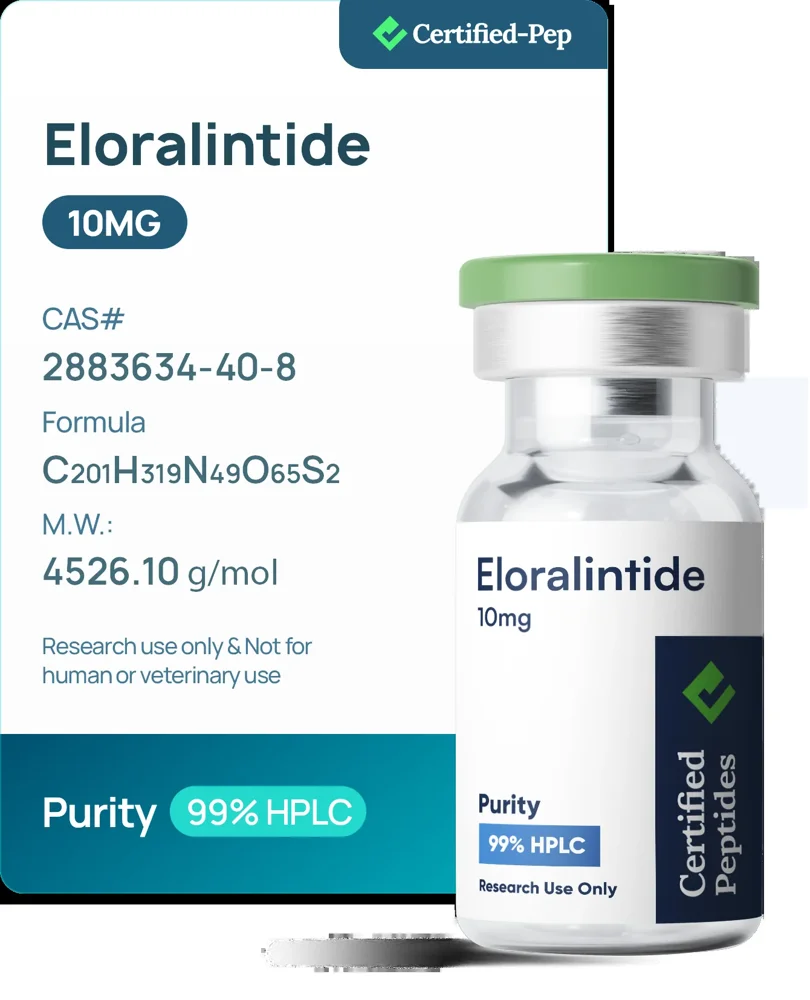
Eloralintide 10mg
$280.00USD · source price
↗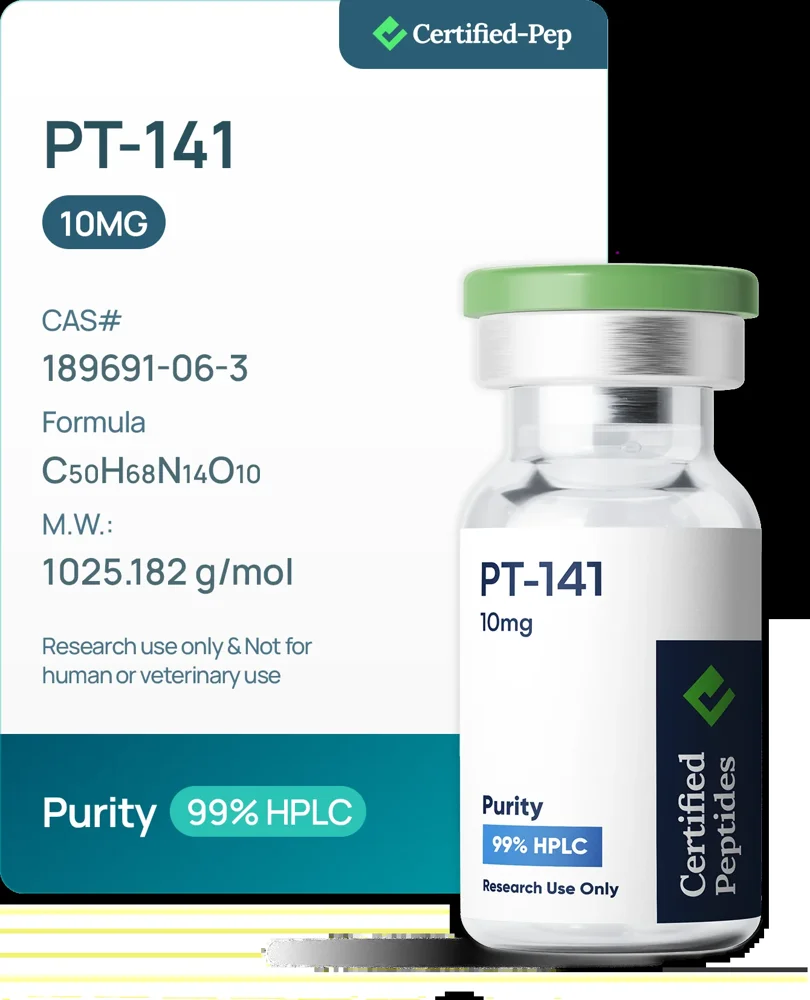
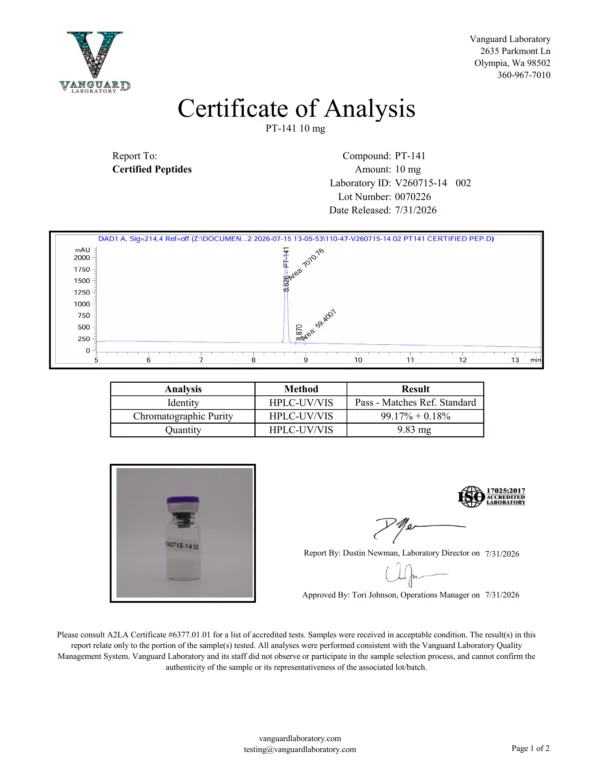
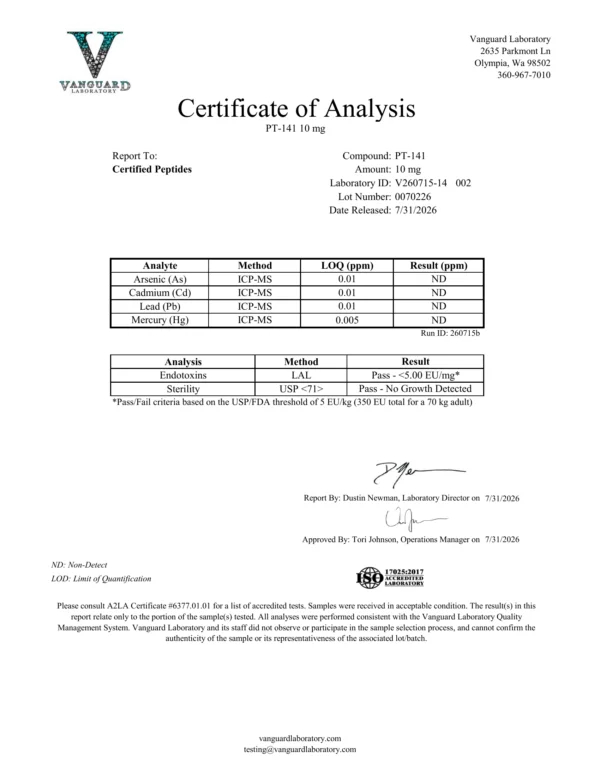
Product imagery supplied by Certified Pep. Images may include packaging or report graphics; confirm exact contents and batch records at the source.
Certified-Pep only sells U.S.-made peptides and products.
Key Features:
Made in the USA
Batch tested at a verifiable U.S. laboratory for identity, content and purity
Screened for endotoxins, heavy metals and sterility
Rigorous quality testing on every batch
All products are delivered in lyophilized powder form
For laboratory and research use only
Adds 1 item and opens the original store’s cart. Final availability is checked there.
| PT 141 10MG | |
|---|---|
| SKU | CP_PT_141_10MG_3ML_VIAL |
| CATEGORY | Research Compound |
| CAS | 189691-06-3 |
| VIAL SIZE | 3 mL |
| FORM | LYOPHILIZED POWDER |
| MOLECULAR WEIGHT | 1025.18 g/mol |
| SEQUENCE | Ac-Nle-cyclo[Asp-His-D-Phe-Arg-Trp-Lys]-OH |
| MOLECULAR FORMULA | C50H68N14O10 |
| ITEM ID | 855 |
PT 141 10MG provides PT-141 (bremelanotide) as lyophilized powder in a 3 mL vial.
PT-141, also known as bremelanotide, is a synthetic peptide that acts as a melanocortin receptor agonist. Its sequence is Ac-Nle-cyclo[Asp-His-D-Phe-Arg-Trp-Lys]-OH, a seven-residue ring with a molecular weight of 1025.18 g/mol. It is a close relative of Melanotan II: the two share the same ring, but PT-141 ends in a free acid where Melanotan II ends in an amide. This vial holds 10 mg of PT 141 peptide as a lyophilized powder for laboratory research.
PT-141 activates melanocortin receptors in the central nervous system, mainly MC4R and MC3R, and acts on related receptors elsewhere in the body. In the hypothalamus, melanocortin signaling is part of the brain pathways that control sexual motivation and natural sexual desire. That is why PT-141 is described as working on desire rather than on blood flow. In female rats, Pfaus et al. (2004) found that a melanocortin agonist increased solicitation behavior, a measure of sexual motivation, without changing other sexual behaviors [1]. That was one of the first lines of evidence that melanocortin signaling can act on desire directly.
Traditional ED medications, the PDE5 inhibitors, work on blood vessels. They relax smooth muscle in the penis and increase blood flow during sexual stimulation, but they don’t act on desire or arousal itself. Unlike traditional ED medications, PT-141 works upstream, on brain pathways, so it was studied as a different approach to sexual dysfunction. That difference is the main reason it attracted research interest in both men and women, and it is part of a new direction in sexual medicine. Most men with erectile dysfunction are first studied with blood-flow drugs, and many men respond to them.
PT-141 was first developed as an intranasal spray. Diamond LE et al. (2004), published in the International Journal of Impotence Research, tested intranasal PT-141 in healthy men and in men with mild to moderate erectile dysfunction [2]. They reported effects on erectile function along with blood pressure increases, which later shaped the drug’s development. The intranasal form for men was not pursued to approval, and PT-141 has no approval for erectile dysfunction, low testosterone or performance anxiety.
Bremelanotide was later developed as a small subcutaneous injection for women. Two 24-week phase 3 trials enrolled 1,247 premenopausal women with acquired, generalized hypoactive sexual desire disorder (generalized HSDD). Bremelanotide produced modest increases in sexual desire scores and decreases in distress compared with placebo [3]. The FDA approved it on June 21, 2019, for acquired, generalized HSDD in premenopausal women [4]. The label states that it does not enhance sexual performance, and there was no difference from placebo in satisfying sexual events [4].
PT-141 sold for research is not that FDA approved product. Use in men, postmenopausal women or anyone outside the approved label would be off label, and research-grade PT-141 is not a new treatment, a peptide therapy or a sexual wellness product.
Among the common side effects on the approved label, nausea is the most frequent, reported in about 40% of women in trials [4]. For most patients it came with the first injection, but about 13% of patients needed medication for it, and severe nausea led some to stop [4]. Bremelanotide also causes a temporary rise in blood pressure and a drop in heart rate after each dose. For that reason it is not recommended for anyone with uncontrolled hypertension or known cardiovascular disease [4]. About 1% of trial participants developed darkening of the gums or skin, which reflects melanocortin activity [4]. Long term safety beyond the trial periods is still being characterized.
Sexual function in people involves hormones, blood vessels, brain pathways, medical history and relationship factors. For most people, low libido and low sexual desire have many causes, including stage of life, and research on a single melanocortin pathway covers only one piece. Questions about sexual health, sexual function or medical history belong with a licensed clinician. This page doesn’t offer a private consultation, personalized treatment plans or guidance on individual response. No information here is intended for sexual activity, sexual confidence, sexual performance or overall wellness in people.
Certified Peptides manufactures in a cGMP facility in Texas. Every batch is tested by an ISO/IEC 17025 accredited US lab for purity (HPLC), quantity, identity (LC-MS), endotoxins, heavy metals and sterility. When you order this PT 141 peptide, match the QR-coded lot on the vial to its report in the COA Library. Keep vials sealed, cold and away from light, and see Lab Testing for the full panel.
Related melanocortin and neuropeptide research compounds include Melanotan II, Kisspeptin-10 and Oxytocin.
The two peptides share the same seven-residue cyclic core, but PT-141 ends in a free carboxylic acid while Melanotan II ends in an amide. That small change shifts receptor activity, and PT-141 was developed specifically for its effects on sexual motivation rather than pigmentation. Both still act broadly across melanocortin receptors, which is why skin and gum darkening appears in the bremelanotide label [4].
PT-141 activates several melanocortin receptors, with the effects on desire attributed mainly to MC4R and MC3R in the brain. It also acts on MC1R, the pigmentation receptor, which explains the darkening reported in trials. Its cardiovascular effects are thought to involve central melanocortin signaling as well.
Melanocortin receptors in the brain help regulate sympathetic nervous system activity, which controls blood pressure and heart rate. Activating them with PT-141 produced a transient rise in blood pressure in both the intranasal male studies and the phase 3 female trials [2], [4]. That finding is why the approved label excludes people with uncontrolled hypertension or cardiovascular disease.
The core animal work used rats, measuring sexual behaviors such as solicitation in females and erections in males. Pfaus et al. (2004) showed that melanocortin activation increased solicitation in female rats without changing other sexual behaviors [1]. Those models helped separate effects on motivation from effects on blood flow.
It has the same peptide sequence, but it is not the approved drug product. The approved product is a specific formulation, manufactured and labeled under FDA oversight for one indication. Research-grade PT-141 is sold only for laboratory research.
For laboratory research use only. Not for human or veterinary use. Not for consumption. This product is not a drug, food or cosmetic. Information on this page is for educational purposes, has not been evaluated by the FDA, and is not intended to diagnose, treat, cure or prevent any disease.