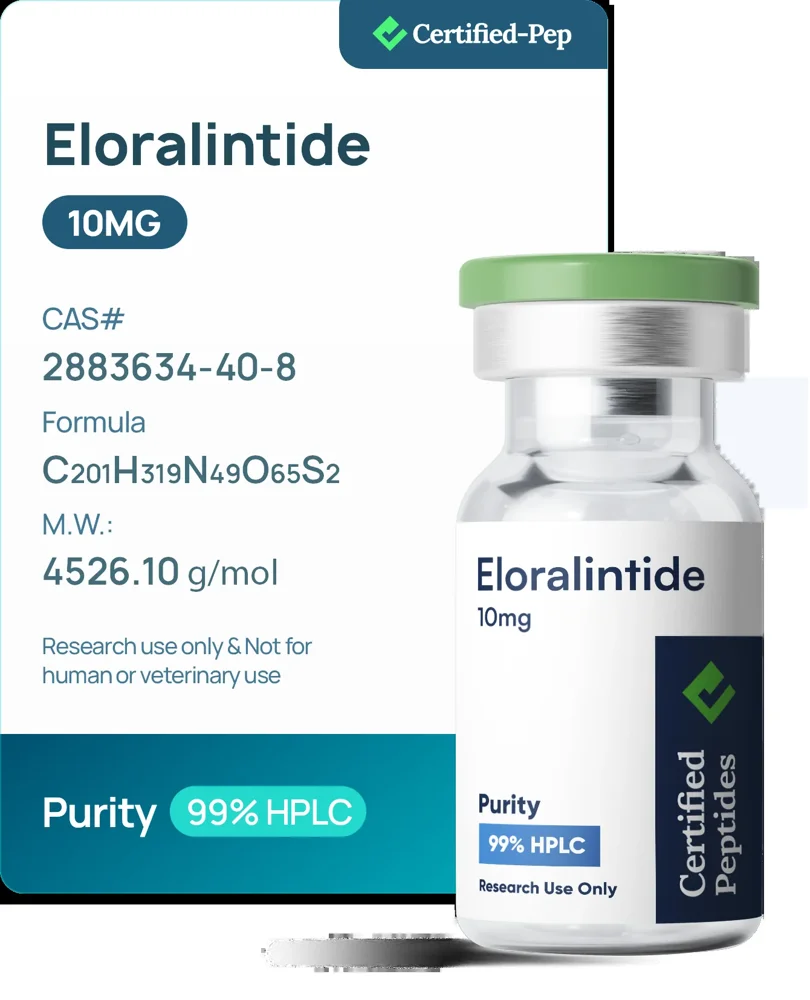
Eloralintide 10mg
$280.00USD · source price
↗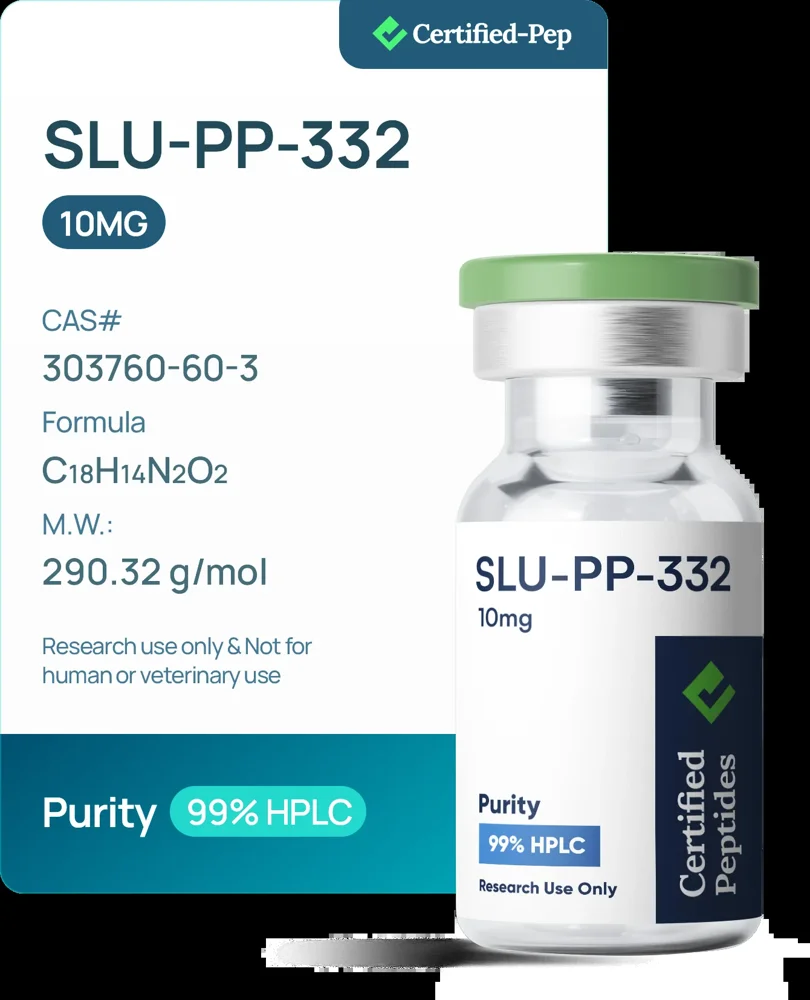
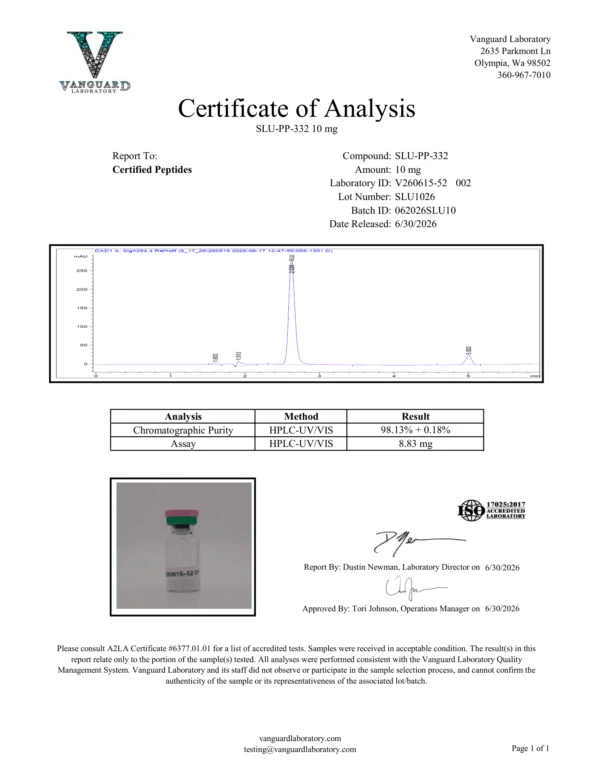
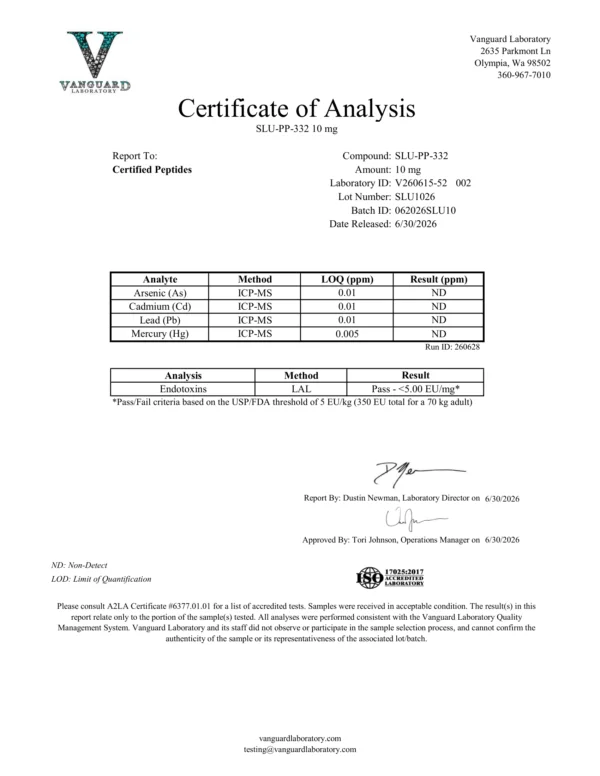
Product imagery supplied by Certified Pep. Images may include packaging or report graphics; confirm exact contents and batch records at the source.
Certified-Pep only sells U.S.-made peptides and products.
Key Features:
Made in the USA
Batch tested at a verifiable U.S. laboratory for identity, content and purity
Screened for endotoxins, heavy metals and sterility
Rigorous quality testing on every batch
All products are delivered in lyophilized powder form
For laboratory and research use only
Adds 1 item and opens the original store’s cart. Final availability is checked there.
| SLU-PP-332 10MG 3ML VIAL | |
|---|---|
| SKU | CP_SLU_PP_332_10MG_3ML_VIAL |
| CATEGORY | Research Compound |
| CAS | 303760-60-3 |
| VIAL SIZE | 3 mL |
| FORM | LYOPHILIZED POWDER |
| MOLECULAR WEIGHT | 290.32 g/mol |
| COMPOSITION | Small Molecule Compound |
| MOLECULAR FORMULA | C18H14N2O2 |
| ITEM ID | 117383 |
SLU-PP-332 was developed through a structure-based design approach and has been characterized as a chemical tool compound for investigating ERR-dependent signaling in nonclinical models. A comprehensive structure-activity relationship (SAR) analysis of the SLU-PP-332 scaffold, integrating cell-based functional assays, gene-expression profiling, and computational modeling, identified key structural determinants that modulate ERRα and ERRγ agonism, transcriptional efficacy, and physicochemical properties [1].
SLU-PP-332 is a synthetic compound that activates the estrogen-related receptors ERRα, ERRβ and ERRγ. It is also searched as SLU PP 332, PP 332 or SLU-PP. It ships in our peptide capsule category and is often called a synthetic peptide, but it is a small molecule, not a chain of amino acids. It was among the first synthetic ligands reported to act as an agonist at ERRα as well as ERRβ and ERRγ, and researchers now use it as a chemical probe to explore ERR signaling in cells and in animal studies. Much of that work asks whether ERR activation can increase fat oxidation in mitochondria-rich tissue such as skeletal and cardiac muscle.
ERRα, ERRβ and ERRγ are orphan nuclear receptors, which means no natural ligand has been identified for them. Despite the name, estrogen does not regulate them. ERRα was named because its gene resembles the estrogen receptor gene. The three receptors control gene networks for mitochondrial biogenesis, oxidative phosphorylation, fatty acid oxidation and the tricarboxylic acid cycle, so they play a role in how muscle and heart tissue make and use energy. They are essential for normal oxidative capacity in muscle: mice that lose ERRs in skeletal muscle develop severe exercise intolerance (Wattez et al., 2023). Poorly working mitochondria also produce more free radicals, which links ERR biology to aging research as well as exercise physiology.
All of the findings below are nonclinical. They come from cell cultures, human-derived cells and mice.
Skeletal muscle. Billon et al. (2023) described SLU-PP-332 as a pan-ERR agonist with the highest potency at ERRα. In a mouse muscle cell line it raised mitochondrial respiration and oxygen consumption. In mice it was associated with a larger share of type IIa oxidative muscle fibers and with an ERRα-dependent gene program that includes Ddit4 and Slc25a25. Genetic experiments pointed to ERRα as the receptor behind these changes. The compound was given by injection in the mouse work, and earlier ERR agonist compounds were mostly limited to in vitro use [2].
Heart. Xu et al. (2024) tested SLU-PP-332 and a structurally different analogue, SLU-PP-915, in a mouse model of pressure overload. RNA sequencing showed that treatment switched on metabolic genes, mainly those for fatty acid metabolism and mitochondrial function. Metabolomics found shifts in fatty acid, lipid and tricarboxylic acid cycle metabolites compared with untreated controls. In cardiomyocytes, genetic experiments identified ERRγ as the main mediator. The authors reported that treatment ameliorated heart failure in the model [3].
Human-derived myoblasts. Bonanni et al. (2025) treated primary myoblast cultures from human skeletal muscle biopsies with SLU-PP-332. Western blots showed higher SIRT1, PGC-1α, ERRα and FNDC5 and lower NOX4. Reduced glutathione went up, and treated cultures formed more myotubes over a 15-day differentiation protocol, a little over two weeks. Myotube formation is a cell-culture marker connected to muscle mass [4].
Chemical optimization. Okda et al. (2026) reported on the chemical optimization of SLU-PP-332 and what it reveals about ERR signaling [1].
Metabolism in liver preparations. Two 2026 papers looked at how liver enzymes break SLU-PP-332 down, an in vitro model of how the body processes a compound. Möller et al. used human liver S9 fractions and microsomes with LC-HRMS/MS and identified six Phase I metabolites and three Phase II conjugates [5]. Avliyakulov et al. used pooled human liver S9 fractions and identified 22 Phase I and Phase II metabolites [6]. Both papers were framed around doping control, so the data also serve as reference material for anti-doping labs.
The science is early. These studies show promise for anyone studying energy metabolism, but the models are cells and rodents, and results in one setup do not automatically carry over to another. The receptor driving the effects can vary by tissue: ERRα in the skeletal muscle work, ERRγ in the heart work. Animal studies also used different doses and schedules, so read the methods sections of the original papers for exact values. This page does not give dosing guidance. SLU-PP-332 has not been approved for use in humans, its safety profile has not been established, and unanswered safety concerns are one more reason to treat it as a laboratory chemical with real risk if mishandled.
Keep the capsules sealed and store them in a cool, dry place away from light, following the storage notes on the batch documentation. The capsule is a transport format and is not intended for time-release. Teams working in vitro often prepare small-molecule stocks in DMSO, so check solvent compatibility and final solvent concentration against your own protocols. Consult your institution’s safety officer before you order or handle the compound, and follow your lab’s risk assessment.
Certified Peptides only sells U.S.-made peptides and products. Every batch is tested at an accredited U.S. laboratory for identity, content and purity, and goes through endotoxin, heavy metals and sterility screening. Capsules are filled for precision research. Match the batch number on your capsules to its certificate of analysis each time you order, since a reorder, even one placed a week later, may come from a different batch.
Is SLU-PP-332 a peptide? No. It is a small synthetic molecule (C18H14N2O2, 290.3 g/mol), though it is sold in the peptide capsule category and often searched as a peptide.
How does SLU-PP-332 act on cells? It is an agonist at ERRα, ERRβ and ERRγ, with the highest potency reported at ERRα. In the studies above, that activation shifted expression of genes tied to mitochondrial function and fatty acid metabolism, which is how the compound works at the cellular level.
Is it for people? No. SLU-PP-332 is sold for laboratory research only.
For laboratory research use only. Not for human or veterinary use. Not for consumption. This product is not a drug, food or cosmetic. Information on this page is for educational purposes, has not been evaluated by the FDA, and is not intended to diagnose, treat, cure or prevent any disease.
-The ERR pathway is significant for research in obesity and metabolic syndrome.